

It’s nearly September, and your friends might share this meme for several hours on the first. In the early days of online social media, Filipinos posted Christmas messages at midnight on the day. But nowadays, people would make fun of this overly-advanced holiday spirit and place Jose Mari Chan’s face in their profiles.
But would Filipino Christmas be complete without Jose Mari Chan’s “Christmas in Our Hearts?” Initially released in 1990, this album became the best-selling OPM album of all time and has been in the top-selling charts for albums since then. Filipinos worldwide would know that cassette tapes and CDs of the album would be played starting September 1st.
If you have read this blog, you will know that I, too, am a junkie for Christmas. This season brings back wonderful childhood memories, and its Christian side has always been a story of hope and love for all generations. But why is there a need for an extended celebration?
A Time to Cringe

For Hiligaynon speakers, August is often called tigkiriwi, a time marked by poverty and hardships. For people working in rice fields and sugar cane plantations, the month is when the rice fields are not yet ready for harvest, and sugarcane mills are not yet active. Tigkiriwi comes from the root word kiwi, which means “turned or twisted aside, awry, oblique, inclined, sloping, slanting, leaning, canting, crooked.” The cringing face is the hallmark of this month.
Those working in sugarcane plantations would say that this month is part of the Tiempo muerto, or dead season, which starts in April, covering the Holy Week celebrations commemorating Christ’s suffering, death, and resurrection.
These facts alone tell that August is a sad month for people, especially those in Western Visayas. With no harvest in sight and all the funds spent on enrollment fees and other school needs in June, the tigkiriwi season will surely elicit cringing faces from struggling families trying to make a living. This fact also explains why the planned change of the school calendar in the country may not be an excellent idea.
Given these, Filipinos seek something to draw them out of the worries of August. September poses as a symbol of hope.
Ber months or Beer months?

The last four months of the year all end in -ber, and the ingenuity of Filipinos led to coining the term Ber Months to refer to them. Christmas music would be heard from malls, most notably SM malls nationwide, which would set a schedule for playing holiday tunes. FM stations also start playing them from time to time.
In the past, people would even try to decorate their homes before September 1st to embrace the festive feeling of the coming season. While this phenomenon has decreased recently, many families and establishments would still try to do this feat.
Meanwhile, people would eventually associate beer with the Ber Months. A 2001 survey of subjects aged between 15 and 74 years (total sample size n = 10 240) found that the rate of regular drinking was 11.1% (total), 13% (males), and 5.9% (females). Regular drinking was defined as drinking four days or more per week. But if you’re around the community, you would see that beer consumption is rising during these months.
With the initiative of a local beer brand to bring the German celebration of Oktoberfest into the country, the emergence of the Beer Months moniker was legitimized. Unlike other Oktoberfest celebrations, this coincides with the Ber Months, which have various celebrations across the archipelago from September to December. However, the German Club in Manila also celebrates this event, albeit more faithfully than the original festival, which is in its 79th year as of this writing.

Perhaps this association only proves how right the tigkiriwi idea of the previous month is. With beer, people can be happy and festive.
A Coping Mechanism
Maybe this early celebration of Christmas is nothing but a coping mechanism. The country has experienced various hardships in the past. From its three centuries under Spanish rule to the Marcos dictatorship, one can see how the need for a long-term celebration is imminent here.
As of this writing, the country is bracing itself for the 10th typhoon to enter the area. Typhoons enter the country’s area of responsibility during the last part of May and would reach until December. The country has been called the most exposed country in the world to tropical storms, and though these storms may hamper Christmas celebrations, the mere promise of happiness by the season aids in coping with the stress they may bring.
“I remember the Child…”
The Philippines is known to be the fourth largest Christian country in the world, with 90% of Filipinos as Christians, which consists of 80.1% Roman Catholic, 1.8% Evangelical, 0.7% Iglesia ni Cristo, 1.1% Aglipayan, and 2.2% other Christian groups including other Protestant denominations. Most of these Christian groups celebrate Christmas, and because of this, it is not surprising that Christmas is a famous celebration in the country.
The Christ child has been viewed as a symbol of hope in the country. The Gospel message of God sending His only Son to save humanity has been the closest idea of redemption for the people. The promise of a new life in Christ and His coming may have enticed people to love the celebration that comes only once a year.
Christmas Economics
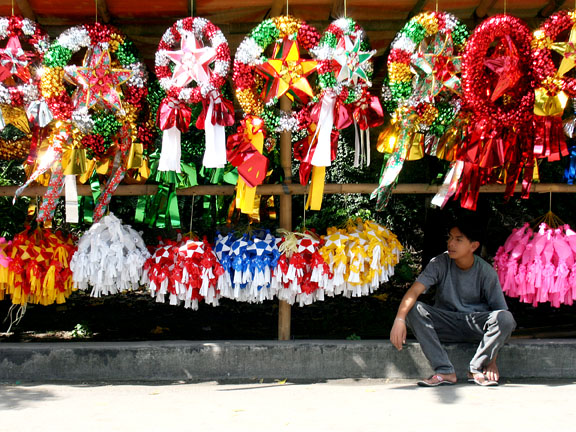
Of course, Christmas also promises better earnings for business owners and more compensation for wage earners. The rise of sales because of buying gifts, decorations, and food, plus the added consumption of electricity and personnel is what it takes for the economics of Christmas to be deemed beneficial.
The country has Presidential Decree No. 851, or the 13th-Month Pay Law, that provides employers with extra pay for regular employees by December 24th every year, perhaps to give more purchasing power to employees during the holiday season.
Meanwhile, government employees in the country also get their 14th-month pay by virtue of Budget Circular 2017-2, covering all civilian, uniformed, and military personnel who have been in government service for at least four months since July 2016. This pay is given as a midyear bonus in May.
However, the Philippine Statistics Authority gathered data in 2014 and concluded that more than a quarter of the total establishment employment was non-regular workers. The employment of nonregular workers in establishments with at least 20 workers as of June 30th, 2014, was at 1.336 million – more than a quarter (29.9%) of the total establishment workforce of 4.472 million. This only means that these non-regular workers cannot avail of the abovementioned provisions. The issue of contextualization is still widespread in the country, even with the Department of Labor and Employment’s policy of banning endo in 2016.
Merry Christmas sa gihapon!

Maybe all of these woes still lead people to find ways to comfort themselves. Christmas is a simple celebration rooted in the modern Christian tradition, solidified by several events in the people’s lives. All of the reasons I gave may just be that. But Filipinos’ long celebration of Christmas is a beauty to behold.
And before Jose Mari Chan serenades you, let me be the first to greet you: Merry Filipino Christmas!
May that star on Christ’s still shine today and give us hope ’til Christmas Day!
[youtube https://www.youtube.com/watch?v=CVw0wcLTOoE]
